Warehouse Perimeter Fencing in Brownsville Industrial
Industrial sites along the Brownsville freight corridors face a distinct set of security challenges that residential or light commercial fencing simply cannot address. The density of cargo movement, the proximity to the Port of Brownsville, and the scale of warehouse footprints in areas like the Brownsville Economic Development Council industrial parks all demand a fencing approach built around perimeter integrity, not aesthetics. If you manage or own a warehouse in Brownsville's industrial zones, understanding the full scope of perimeter fencing options is one of the most practical steps you can take to protect assets, reduce liability, and meet insurance requirements.
Why Industrial Perimeter Fencing Differs from Standard Commercial Fencing
Most commercial fencing projects involve defined entrances, moderate foot traffic, and visible deterrence as the primary goal. Warehouse perimeter fencing on an industrial scale requires a different framework entirely. You are dealing with long fence runs, often spanning hundreds of linear feet without natural breakpoints, vehicle traffic at multiple entry zones, and the continuous pressure of opportunistic intrusion along the full perimeter.
In Brownsville's industrial corridors near International Boulevard and the Port Access Road, warehouses often sit adjacent to one another with shared fence lines or minimal setback. That proximity creates gaps in coverage that a standard chain-link or wood panel fence will not close. Industrial perimeter fencing must account for those adjacencies, for unmonitored rear sections, and for the fact that intrusion may not come from a single access point but from any weak segment in a long run.
Anti-Climb Mesh and Height Standards for Brownsville Warehouses
Height is the first line of deterrence. Most warehouse perimeter applications in Texas industrial zones start at eight feet minimum, with ten to twelve feet being common for high-value cargo operations. Cameron County and City of Brownsville zoning for industrial-classified parcels generally permit fence heights in this range without a variance, though it is always worth confirming current regulations for your specific parcel classification before installing.
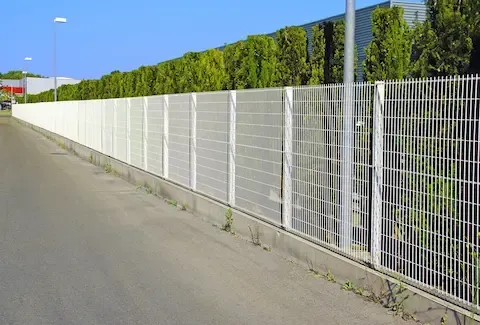
Anti-climb mesh, sometimes called security mesh or welded wire panel fencing, is a step up from standard chain-link in deterrence value. The small aperture of welded wire mesh, typically two inches by two inches or smaller, makes it extremely difficult to get a foothold on the fence face. When combined with a height extension using outward-angled brackets and barbed wire or razor coil, you create a perimeter barrier that significantly slows unauthorized entry even if someone is determined to attempt it.
For warehouse perimeter fencing in Brownsville, welded wire mesh panels in eleven or nine gauge wire provide a balance of visibility, airflow, and structural resistance. They also hold up well in South Texas heat cycles, with galvanized or powder-coated finishes resisting the corrosion that Brownsville's humid subtropical climate accelerates on unprotected steel.
Lighting Integration Along the Fence Line
A fence without lighting is a fence that stops working at dusk. For warehouses operating night shifts or storing cargo overnight, perimeter lighting integrated with the fence line is not optional — it is a baseline security requirement that most commercial insurers now expect to see documented.
Lighting integration on an industrial fence line typically involves post-mounted fixtures at calculated intervals, motion-activated zones in low-traffic perimeter sections, and coordinated coverage that eliminates shadow gaps. When you plan the fence layout, post placement can be designed to accommodate fixture mounting so that lighting poles and fence posts share the same footprint where feasible. This reduces ground penetrations, lowers installation cost, and produces a cleaner, more maintainable perimeter line.
In Brownsville's industrial parks near FM 511 and the rail access corridors, facilities that have integrated perimeter lighting with their fence systems report substantially fewer trespass incidents and faster response times when motion events do trigger. The combination of visible deterrence and eliminating concealment is more effective than either element alone.
Gate Access Control on Warehouse Perimeters
Your gate system is where the security value of your entire perimeter fence either holds or fails. A well-constructed fence line with an undermaintained or undersized gate represents the weakest point in your perimeter, and experienced trespassers know to look for it.
For warehouse operations, gate access control typically involves one or more of the following: slide gates for vehicle access lanes, swing gates for secondary pedestrian entry, and electric operators with access credential readers. Credential systems range from keypad entry codes to proximity card readers to full biometric systems depending on the security tier your operation requires.
Vehicle-rated gates in industrial applications should be heavy enough to resist ramming pressure, especially for facilities near high-traffic freight routes in Brownsville. Crash-rated barriers and drop arms can supplement the primary gate structure at high-security facilities. For most warehouse perimeters, however, a properly specified slide gate with electric operator, photo-eye safety sensors, and a card reader at both entry and exit lanes covers the operational requirements without overengineering the system.
Pairing your gate access control system with a CCTV feed ensures that gate events are documented. This is increasingly a condition of commercial property and cargo insurance in South Texas industrial zones, and having that documentation available simplifies any claims process significantly.
Material Choices for South Texas Industrial Environments
Brownsville's climate is hard on metal. High humidity, salt air proximity from the Gulf, and temperature swings between summer highs and winter fronts all accelerate corrosion on unprotected steel. For warehouse perimeter fencing, material selection needs to account for long-term maintenance cost, not just upfront installation price.
Galvanized steel, either hot-dip galvanized or electro-galvanized with a powder coat topcoat, provides the best corrosion resistance for most industrial fence applications. Aluminum is lighter and naturally corrosion-resistant but does not provide the same structural resistance for perimeter security applications at height. Chain-link with a vinyl coating offers some additional corrosion protection over bare galvanized but still requires periodic inspection of the coating for breaks that allow moisture intrusion.
For long perimeter runs in Brownsville industrial zones, hot-dip galvanized welded wire mesh panel systems with powder-coated steel posts are consistently the most durable and cost-effective combination over a ten to fifteen year lifecycle. They require less maintenance than chain-link, resist the specific environmental stressors present in Cameron County, and meet the structural requirements of commercial and industrial insurance standards.
Working with a Local Fence Contractor Who Knows Industrial Requirements
The difference between a general fence contractor and one experienced in industrial perimeter work shows up immediately in how they approach the site assessment. An experienced contractor will walk the full perimeter, identify grade changes that require custom post depth or panel adjustment, note existing utility conflicts, and flag any local setback or height requirements that apply to your parcel classification in Brownsville.
If you are evaluating options for your warehouse site, reviewing our commercial fence overview provides context on how commercial and industrial fence projects are scoped and priced in this market. For a direct conversation about your perimeter requirements, Commercial Fence Installation is the right starting point to get a site-specific recommendation rather than a generic quote.
Warehouse operators along Brownsville's industrial corridors near the Port and along Highway 48 deal with real security pressure. Getting the perimeter fence specification right from the start — height, material, lighting integration, and gate access — is a decision that pays forward in reduced incidents, lower insurance costs, and fewer operational disruptions for the life of the facility.
